
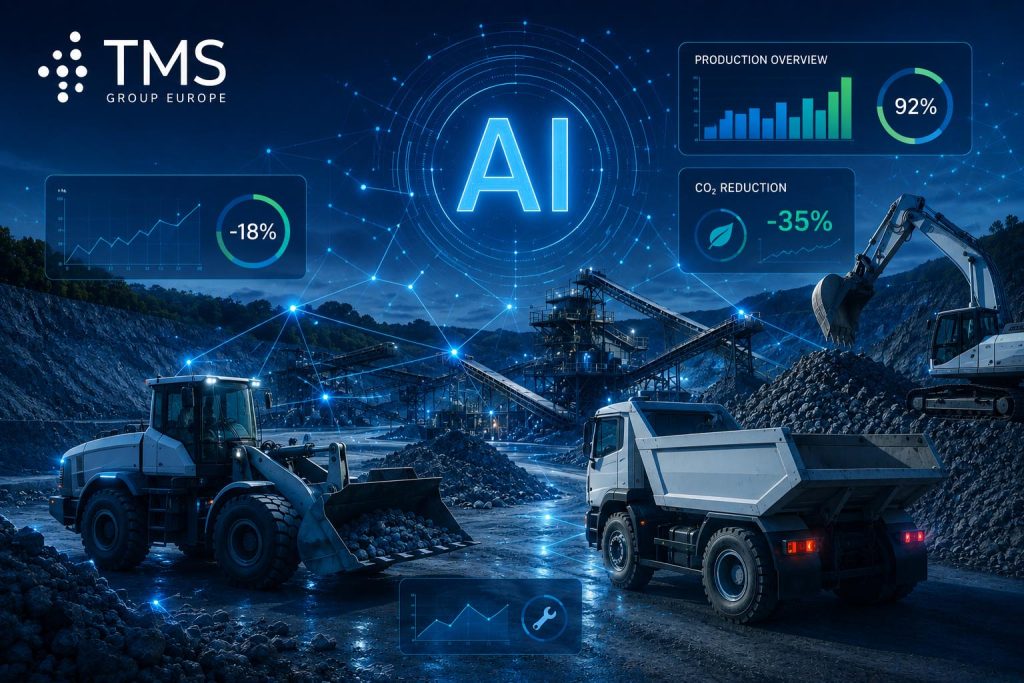
Data Was the Beginning. AI Is the Next Step.
For many years, the aggregates industry has been investing in advanced production technologies. Modern quarries operate increasingly efficient processing plants, sophisticated control systems, and advanced telemetry solutions.
At the same time, the volume of data generated every day by machines, energy systems, transport equipment, and production management systems continues to grow.
At Hillhead 2026, we saw numerous innovative technologies. However, one thing has become increasingly clear: the future of the industry will not depend solely on how much data companies can collect.
The real challenge lies in interpreting that data and using it to make better operational decisions.
That is why artificial intelligence is becoming an increasingly important part of modern quarry operations.
From Reporting to Decision Support
For many years, industrial software systems primarily served as reporting tools.
They collected operational data, displayed performance indicators, and enabled historical production analysis.
Today, their capabilities extend far beyond reporting.
Modern AI algorithms can analyse thousands of operational parameters simultaneously, identifying relationships that are difficult—or even impossible—to detect through traditional report analysis.
As a result, users receive not only raw data but also insights into its significance and its potential impact on operational performance.
This represents a fundamental shift in the way industrial facilities are managed.
AI as a Decision Support Tool for Production Managers and Shift Supervisors
One of the most valuable applications of artificial intelligence is supporting day-to-day operational decision-making.
In practice, AI can automatically identify:
- decreases in production efficiency,
- abnormal machine behaviour,
- increasing energy consumption,
- inefficient use of operational resources,
- deviations from production plans as well as deviations from expected process performance profiles.
Instead of analysing dozens of reports and dashboards, production teams receive clear information indicating which parts of the process require attention.
This enables faster responses to changing operating conditions and helps reduce losses before they affect production performance.
Predictive Maintenance
Unplanned downtime remains one of the most expensive challenges in processing plants.
Every hour of downtime for a crusher, screen, or conveyor results in lost production and increased operating costs.
Artificial intelligence enables organizations to move from reactive maintenance to a predictive maintenance strategy.
By analysing historical data together with real-time operating parameters, AI systems can identify early warning signs indicating deteriorating equipment condition.
This includes components such as:
- drive systems,
- bearings,
- conveyor rollers,
- electric motors,
- hydraulic components.
As a result, maintenance activities can be scheduled before failures occur, significantly reducing the risk of costly production interruptions.

Intelligent Energy Management
Rising energy prices have made energy efficiency one of the highest operational priorities.
AI enables energy consumption to be analysed in the context of actual production performance and plant operating conditions.
The system can automatically identify:
- the most energy-intensive processes,
- unusual increases in energy consumption,
- declining energy efficiency,
- areas with the greatest optimisation potential.
Equally important is the ability to correlate energy data with production Key Performance Indicators (KPIs).
This provides decision-makers with a complete operational picture rather than isolated energy reports.
AI and Internal Logistics
Internal logistics plays a crucial role in the overall performance of an aggregates operation.
Wheel loaders, excavators, haul trucks, and other mobile equipment form an integral part of the production process.
Artificial intelligence can analyse:
- haul cycle times,
- loading queue efficiency,
- equipment utilisation,
- idle machine time,
- material flow between different production stages.
This makes it possible to identify operational bottlenecks that often remain hidden in conventional reporting systems.
From Data to Actionable Recommendations
The greatest transformation AI brings to industry is not simply the automation of reporting.
Its real value lies in converting operational data into actionable recommendations.
Rather than merely notifying users that a problem has occurred, AI can also indicate:
- possible root causes,
- areas requiring immediate attention,
- actions that may improve operational performance,
- risks that could affect future production results.
This capability will become one of the defining industrial trends of the coming years.
The Future of the Aggregates Industry
Only a few years ago, competitive advantage was primarily built through investments in modern equipment and higher machine productivity.
Today, data has become equally important.
In the years ahead, the ability to interpret that data and use it effectively in decision-making will become an even greater competitive differentiator.
Artificial intelligence will not replace the experience of operators, process engineers, or production managers.
Instead, it will increasingly support their daily work by helping them identify problems more quickly, reduce operational losses, and make better use of available resources.
Conclusion
Hillhead 2026 provided an excellent opportunity to explore the latest technologies shaping the aggregates industry. However, it is worth looking beyond production equipment alone and focusing on solutions that improve data management and operational decision-making.
Artificial intelligence will play an increasingly important role in enhancing the operational performance of quarries and processing plants over the coming years.
The future of the aggregates industry will belong to organizations such as TMS Group Europe, capable of combining human expertise, operational data, and the power of artificial intelligence into a single, integrated decision-support ecosystem.